

US Ports Cyberattacks: LA Blocks 120M Attempts
The Port of Los Angeles blocked 120 million cyberattack attempts in a single month. Explore why hackers target US ports and key supply chain defenses.
Quick answer and first action
America's busiest maritime gateways are facing an unprecedented wave of automated, AI-assisted, and targeted cyberattacks. In August alone, the Port of Los Angeles blocked roughly 120 million cyberattack attempts — nearly double its 2023 monthly average — while energy hubs, regional container terminals, and U.S.-bound energy tankers dealt with persistent daily probing, executive spear-phishing, and operational disruptions.
Put it into practice: If your business connects to freight, logistics, customs, or energy supply chains, treat external partner portals and executive email as primary targets. Enforce phishing-resistant MFA immediately, isolate operational systems from general office networks, and drill manual fallback procedures before an intrusion hits live operations.
For years, maritime security planners focused mostly on physical cargo screening and storm resilience. That baseline has changed dramatically. Recent reporting highlighted by Gulf News and major financial press investigations shows that digital attacks against U.S. ports and ocean shipping lanes have escalated from sporadic opportunistic scans into relentless, high-volume pressure on global trade arteries.
Inside the Numbers: 120 Million Blocked Attempts at the Port of Los Angeles
At the Port of Los Angeles, the nation's busiest container gateway, defensive telemetry recorded approximately 120 million attempted cyberattacks in August — roughly twice the port's average monthly attack volume from 2023.
According to disclosures from Port Executive Director Gene Seroka, the barrage encompassed a broad spectrum of hostile activity rather than simple nuisance traffic:
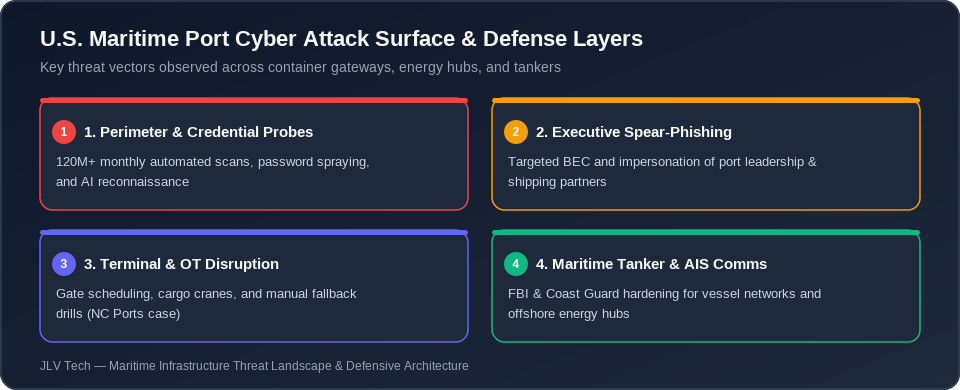
- Automated intrusion scans probing public-facing web portals, VPN gateways, and remote vendor interfaces for unpatched software flaws.
- Credential harvesting and password spraying aimed at hijacking employee, terminal operator, and third-party drayage logins.
- Network exploitation and perimeter probing searching for lateral pathways between business IT systems and port operations.
- Malware and ransomware staging designed to paralyze terminal scheduling or extract extortion payments during peak shipping windows.
While the Port of Los Angeles absorbed and deflected the August surge without halting cargo movement, security leaders warn that sheer volume shifts the odds in favor of attackers: defenders must block millions of attempts without error, whereas an adversary only needs a single unpatched appliance or phished credential to gain an initial foothold.

From Texas Oil Hubs to the Strait of Gibraltar: A Coordinated Maritime Surge
The pressure in Southern California is part of a wider maritime pattern affecting container ports, energy export terminals, and vessels at sea.
Port of Corpus Christi: Daily Probes and Executive Impersonation
At the Port of Corpus Christi in Texas — the largest crude oil export hub in the United States — leadership including CEO Kent Britton reported facing hundreds to thousands of automated and AI-assisted intrusion attempts every single day. Beyond brute-force network scans, attackers launched tailored spear-phishing campaigns impersonating senior port executives to trick staff or partner organizations into revealing credentials or authorizing fraudulent transactions.
North Carolina Ports: When Cyber Intrusions Stop Gate Operations
The operational cost of a successful intrusion became clear in August at North Carolina Ports. After a cyberattack disrupted internal IT systems, port operators experienced gate delays and had to temporarily switch to manual cargo processing to keep freight moving. Even a short-lived fallback to paper and manual verification ripples outward across trucking schedules, warehouse staging, and regional retail supply chains.
Energy Tankers Investigated Near the Strait of Gibraltar
Threat activity has also extended offshore. The U.S. Coast Guard and the FBI investigated suspected cyber intrusions targeting the digital networks of two U.S.-bound energy tankers near the Strait of Gibraltar. Combined with the Coast Guard's earlier disclosure of a 17% increase in maritime cyber incidents, federal officials increasingly view port terminals, pipeline connectors, and vessel navigation or communications suites as an interconnected target set.

Incident Breakdown Across Major Maritime Gateways
The scope of recent maritime cyber pressure spans public-sector port authorities, energy exporters, regional terminals, and commercial vessels:
| Facility or Asset | Reported Scale / Incident | Observed Operational Impact | Primary Attack Vector |
|---|---|---|---|
| Port of Los Angeles | ~120 million blocked attempts in August (nearly 2× 2023 monthly average) | Blocked by layered perimeter and SOC defenses; no halt reported | Automated scans, credential harvesting, network probing, malware delivery |
| Port of Corpus Christi | Hundreds to thousands of automated and AI-assisted probes daily | Heightened defensive monitoring and executive phishing alerts | Network vulnerability probing and executive impersonation spear-phishing |
| North Carolina Ports | Confirmed August IT disruption | Gate delays; temporary shift to manual cargo processing | Network intrusion affecting terminal IT workflows |
| U.S.-Bound Energy Tankers | Suspected digital intrusions near the Strait of Gibraltar | Joint U.S. Coast Guard and FBI cyber investigation | Shipboard digital network and maritime communications exposure |
Why Critical Port Infrastructure Is in the Crosshairs
Ports sit at a uniquely fragile intersection of physical logistics, legacy industrial hardware, and modern cloud ecosystems. Three structural factors explain why threat actors — from financially motivated ransomware crews to state-aligned intelligence operators — prioritize maritime targets:
- Tight IT/OT convergence: Modern terminals depend on real-time software to coordinate ship-to-shore gantry cranes, automated yard gates, customs EDI feeds, and refrigeration telemetry. When corporate IT is breached without strict isolation—or without physical separation like the one-way data diodes used in power grid OT cyber defense—operational technology (OT) can be forced offline out of caution.
- Dense third-party ecosystems: A single major port interacts daily with hundreds of ocean carriers, customs brokers, trucking fleets, rail operators, fuel vendors, and maintenance contractors. Attackers routinely probe the weakest vendor link to pivot inward.
- AI-accelerated reconnaissance and social engineering: As port executives have cautioned, generative AI helps adversaries automate vulnerability discovery, generate convincing maritime-jargon lures, and rapidly craft executive-impersonation emails that bypass traditional keyword filters.
Defensive Playbook: Lessons for Supply Chain and Small Business Operators
You do not have to run a deep-water container terminal to face the exact same tactics hitting Los Angeles and Corpus Christi. Every freight broker, warehouse operator, marine contractor, and small business sits upstream or downstream of critical infrastructure — and attackers exploit smaller suppliers precisely because they often lack full-time security operations teams.
1. Stop Executive Impersonation and Credential Harvesting
When attackers impersonate leadership like they did against Gulf Coast port teams, traditional passwords and SMS codes fail. Combine strict email authentication (SPF, DKIM, and DMARC) from our phishing prevention and response checklist with phishing-resistant FIDO2 passkeys and MFA so a tricked click on a spoofed login page cannot hand over a usable session.
2. Segment Business Networks from Critical Operations
Flat networks turn a single infected office laptop into a facility-wide shutdown. Apply the zone isolation practices in our small business network security checklist and move vendor and remote access toward a phased zero trust architecture so contractors only reach the exact application they are authorized to use.
3. Rehearse Manual Fallback and Offline Recovery
North Carolina Ports kept freight moving because staff could fall back to manual workflows when digital systems went down. Build that same operational muscle into your small business incident response plan: keep contact rosters, containment playbooks, and recovery keys stored offline, verify encrypted backups with regular restore tests, and verify your defensive stack against our 10 essential cybersecurity tool types for small business.
Frequently Asked Questions
Did the 120 million cyberattack attempts shut down the Port of Los Angeles?
No. Port of Los Angeles officials reported blocking roughly 120 million intrusion attempts in August through layered security controls without interrupting terminal operations, though the volume doubled compared to the port's 2023 monthly baseline.
Why are hackers targeting U.S. ports and energy terminals right now?
Ports and crude oil export hubs concentrate enormous economic leverage. Even brief disruptions create costly cargo bottlenecks, pressure organizations into paying ransoms, and offer strategic intelligence or geopolitical leverage over national supply chains.
What happened during the North Carolina Ports cyber incident?
In August, a cyberattack disrupted IT systems at North Carolina Ports, causing temporary gate delays and forcing operators to process cargo manually while technical teams worked to contain and restore digital operations.
How can supply chain vendors and small businesses protect themselves from maritime-style cyberattacks?
Start with high-impact fundamentals: enforce phishing-resistant MFA on all email and remote portals, publish strict DMARC policies to curb executive spoofing, segment guest and vendor access away from core operations, and test offline backups alongside a manual continuity drill.
Related Guides
Strengthen your defenses with our small business cybersecurity fundamentals guide, evaluate secure remote vendor access in our business VPN and zero trust comparison, or explore all cybersecurity guides.
Sources and further reading
- Gulf News: US ports face wave of cyberattacks as Los Angeles blocks 120 million attempts
- CISA: Critical Infrastructure Security and Resilience
- U.S. Coast Guard Cyber Command (CGCYBER)
Product capabilities, threat telemetry, and regulatory guidance can change. Consult the linked primary advisories and your sector compliance authorities for current requirements.